

Why HopChat Exists
The Sovereign Edge: The Post-Quantum E2EE Breakthrough
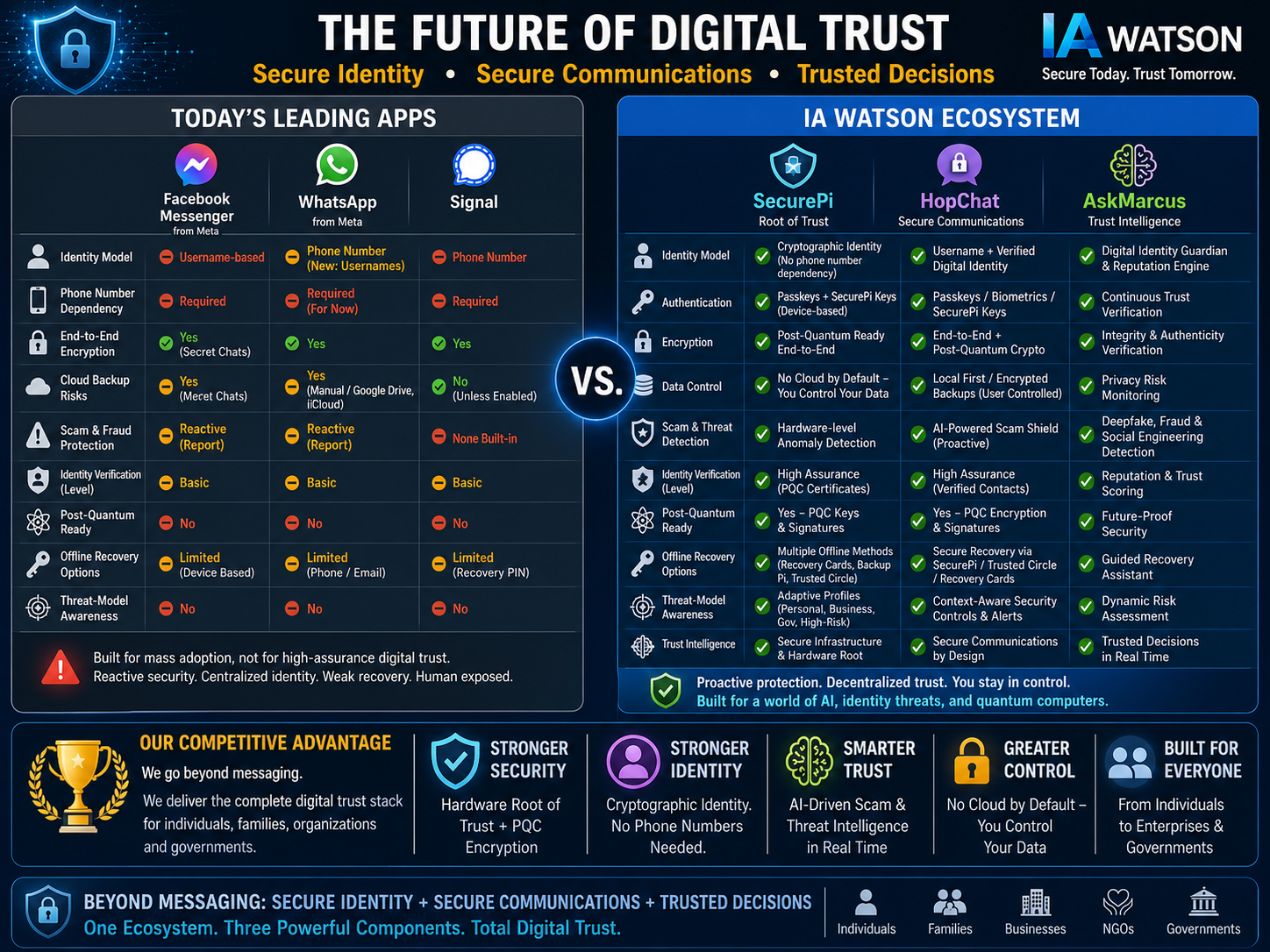
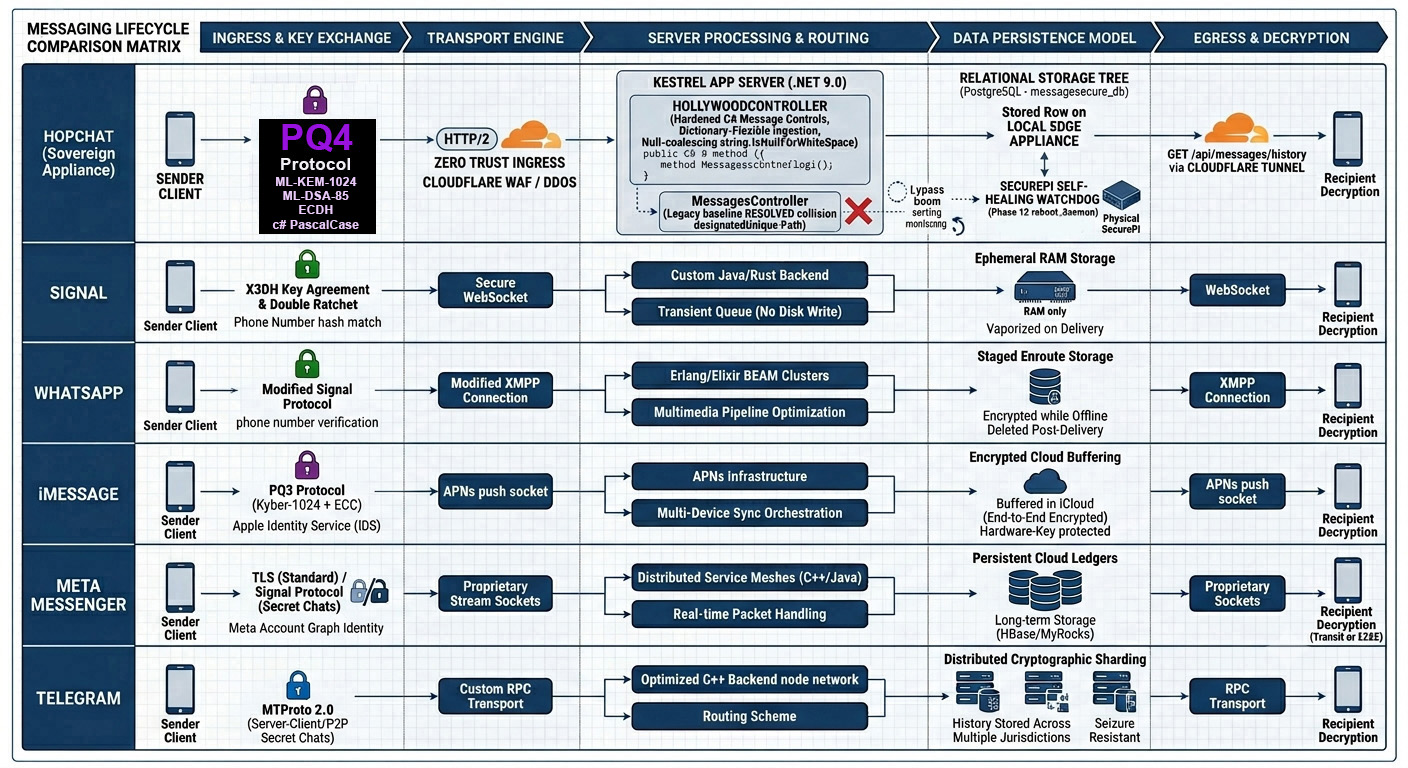
While industry giants like Apple and the GSMA are beginning to integrate end-to-end encryption (E2EE) into mainstream standards like RCS, these implementations remain tethered to centralized corporate silos that manage your identity, route your metadata, and rely on legacy classical cryptography. This creates a dangerous "trust gap" where privacy is merely leased from a provider rather than owned by the user. Even as platforms like Signal lead the commercial space with hybrid post-quantum experiments, the fundamental flaw remains a centralized corporate infrastructure that forms massive honey-pots for surveillance and cyberattacks.
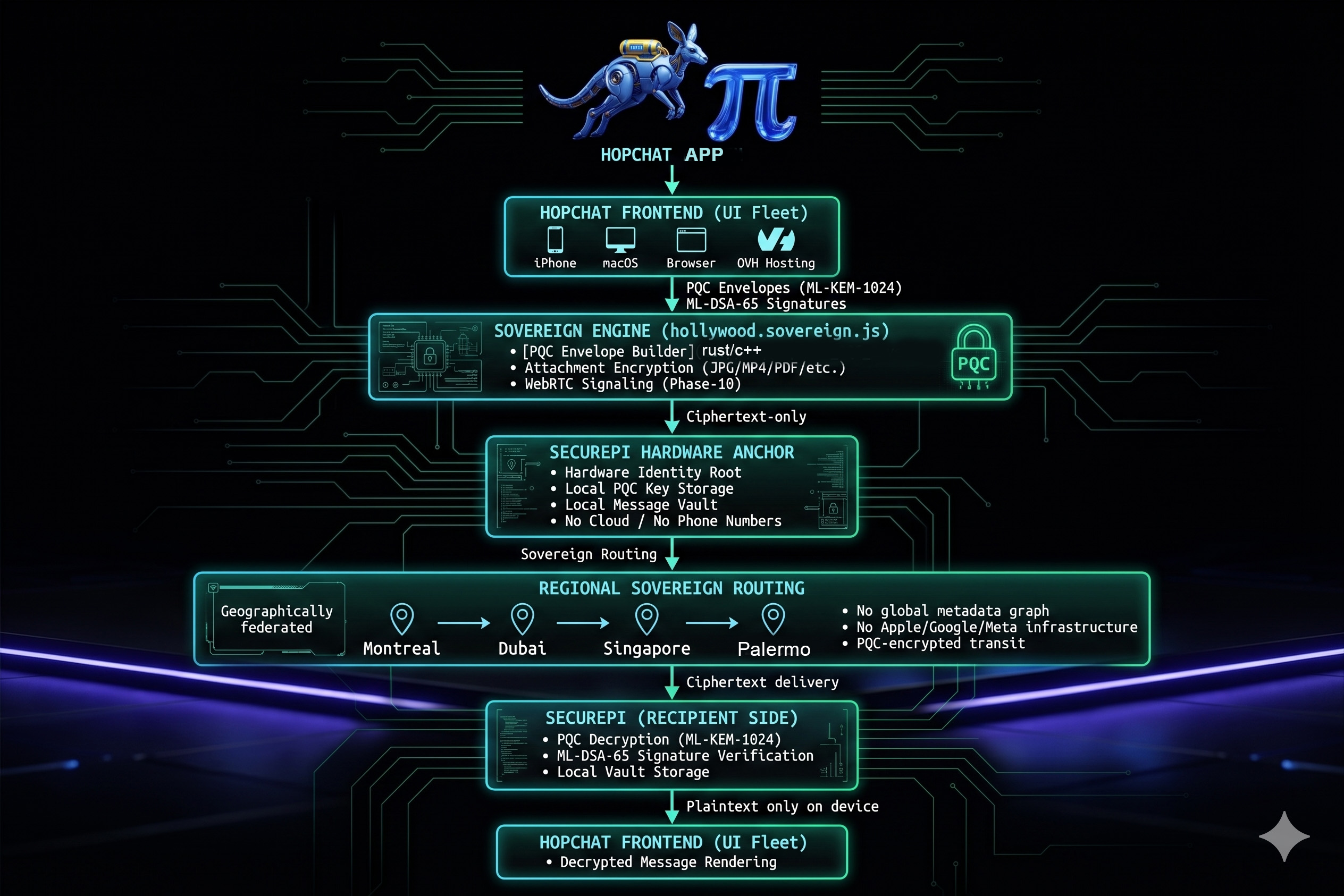
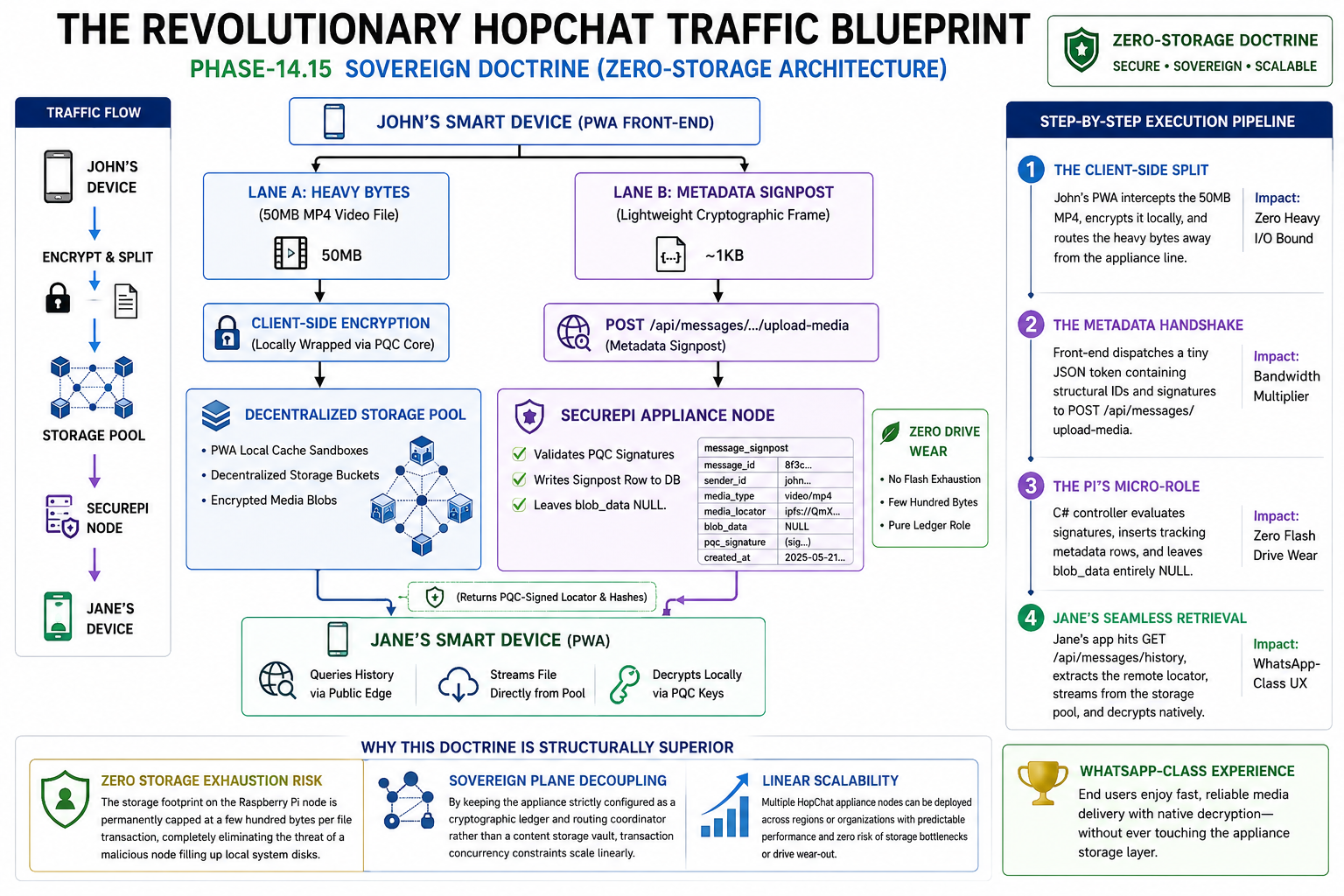
HopChat | MessageSecure represents a paradigm-shifting breakthrough by completely replacing corporate-managed keys with absolute digital sovereignty. By shifting the entire cryptographic brain to the SecurePi—a decentralized, owner-controlled hardware node—we physically decouple your privacy from the cloud.
Operating under advanced Phase 10 protocols, our architecture utilizes a hybrid ML-KEM (Kyber-1024) mechanism for key exchange and ML-DSA (Dilithium-65) for identity anchoring, building an impenetrable, "Shor-resistant" shield against future quantum decryption. Unlike mainstream solutions that route cross-platform traffic through vulnerable corporate corridors, every identity here is anchored in local hardware, and every packet is encapsulated in post-quantum armor.
By ensuring absolute long-term confidentiality and radical metadata minimization, HopChat delivers a sovereign private infrastructure truly resilient against both current surveillance and future quantum threats. This is not just a software update—it is a physical move to a world where you, and you alone, hold the absolute keys to the kingdom.
The right to private communication is fundamental — and it is under siege. Classical encryption schemes that protect the world's digital conversations today will be broken by sufficiently powerful quantum computers within this decade. Most messaging platforms know this. None have acted.
HopChat was founded on a single conviction: that every person, organization, and government deserves messaging infrastructure that is mathematically secure against both present-day adversaries and the quantum computers of tomorrow — without sacrificing usability, without surrendering data to third-party servers, and without a phone number, an email address, or any personally identifying information required to get started.
Sovereign Cryptography & Infrastructure Glossary
A massive corporate telecom consortium representing over 750 global network operators. The GSMA dictates the profile standards for consumer cellular infrastructure. Because its cryptographic standards rely on absolute bureaucratic consensus among corporate and state monopolies, its protocols run on legacy corridors. HopChat intentionally drops beneath this layer, routing your communications completely outside of GSMA-managed carrier infrastructure by running directly through your private, owner-controlled SecurePi mesh.
The modern text messaging protocol pushed by Google and Apple to achieve cross-platform multimedia interoperability. While commercial apps overlay basic encryption onto RCS, it structurally forces your traffic through cellular operator servers and corporate cloud hubs, leaving your system metadata completely exposed. HopChat | MessageSecure shatters this reliance by establishing direct, hardware-to-hardware data handling on the SecurePi, ensuring your routing logs and conversational identity remain entirely private and completely isolated from Big Tech's databases.
A standard paradigm where payloads are encrypted on the device and only decrypted by the receiver. However, standard apps like WhatsApp or iMessage maintain a deep trust gap: the companies own the centralized registry servers that hand out the public keys, allowing them the theoretical power to perform key-substitution operations. HopChat brings a historic breakthrough to E2EE by completely removing corporate-managed directories; your SecurePi serves as your independent identity anchor, giving you absolute ownership of the keys.
The pinnacle NIST-standardized public-key encapsulation protocol (FIPS 203) designed to withstand quantum computer cryptanalysis using multidimensional lattice math. While competitors like Signal utilize lower security variants (Kyber-768) wrapped over traditional systems in hybrid configurations, HopChat enforces full ML-KEM-1024 parameters. This brings Level 5 cryptographic security—equivalent to or exceeding AES-256 brute-force hardness—directly to your SecurePi, ensuring communications cannot be targeted by "Harvest Now, Decrypt Later" quantum collection strategies.
A highly advanced post-quantum digital signature algorithm (FIPS 204) built on the mathematical complexity of module lattice vector configurations. While commercial networks still verify signatures using legacy classical cryptography (vulnerable to upcoming quantum extraction), HopChat locks its entire infrastructure behind an ML-DSA-65 verification loop. Operating on the SecurePi as a dedicated Sentinel Gate, this logic strictly audits every single incoming packet, instantly dropping untrusted, altered, or forged code vectors before they can interact with the system.
An engineering standard confirming that a system's core mathematical math is entirely immune to execution under Shor’s Algorithm. Traditional public-key schemes (RSA, ECC, Diffie-Hellman) rely on integer factorization that quantum platforms can shatter instantly. By moving away from legacy integer structures and deploying geometric module lattices, the HopChat | MessageSecure paradigm remains entirely Shor-resistant, ensuring that transactions handled by your decentralized SecurePi are mathematically secure across the horizon of quantum expansion.
Toolbar Button Reference
New
Opens a blank message composer and launches the recipient selection screen. Use this to initiate a fresh one-to-one or group conversation with any HopChat contact or ID. A new Double Ratchet handshake is performed automatically when the first message is sent.
⬡ Keyboard shortcut: Ctrl + N on desktopSend
Encrypts the current message composition (text + any attachments) with the recipient's ML-KEM-1024 public key, advances the Double Ratchet session state, and transmits the resulting ciphertext through the zero-knowledge relay. The button is active only when both a recipient and message content are present.
⬡ Messages are encrypted locally before leaving your deviceContacts
Opens your HopChat address book — a local, encrypted list of contacts you have verified and saved. Each contact entry stores the person's HopChat ID and their verified public key fingerprint. Your contacts list is stored exclusively on your device and is never synced to HopChat servers.
⬡ Import contacts via QR code scan or manual HopChat ID entryChoose Recipients
Opens the recipient picker for the current message. Search by HopChat display name or ID, or select from your Contacts. For group messages, add multiple recipients sequentially. Each recipient's public key is fetched and verified before encryption — you will be warned if a key has changed since your last conversation.
⬡ Key-change warnings require your manual re-verification before sendingAttach
Opens your device's file browser to select any document, PDF, spreadsheet, archive, or other file for attachment. Selected files are chunked and encrypted client-side before upload. The server receives only encrypted binary chunks and has no visibility into file type, name, or content.
⬡ Max attachment size: 2 GB per fileCamera
Opens your device camera to capture a new photo directly within HopChat. The captured image is encrypted immediately in memory before being written to any temporary storage — it is never saved to your device's camera roll unless you explicitly save it. Tap to shoot; confirm to attach to the message.
⬡ Images are stripped of EXIF metadata before encryptionVideo
Opens your device camera in video recording mode. Record a clip and confirm to attach it encrypted to your outgoing message. As with photos, video files are encrypted in memory and stripped of metadata before transmission. Long recordings are streamed in encrypted chunks rather than buffered entirely.
⬡ Video clips are encrypted frame-by-frame before uploadVoice
Records a voice note using your device microphone. Tap once to begin recording (you will see a waveform and timer), tap again to stop. The audio is immediately encrypted and attached to the current message. Voice notes appear as playable waveforms in the recipient's conversation thread.
⬡ Max voice note duration: 10 minutesShare My Screen
Initiates a live screen share of your device display to the current call participant. Screen share data is transmitted over the same post-quantum encrypted WebRTC channel as the voice/video call. The remote party can see your screen in real time. Tap again to stop sharing at any moment.
⬡ Available during active voice or video calls onlyAsk to Share Screen
Sends the other call participant a request to share their screen with you. They will receive a prompt that they must explicitly accept before their screen becomes visible to you. This button does not force or enable screen sharing on the remote device — consent is always required from the other party.
⬡ Request can be declined at any time by the remote partyKill Switch
CRITICAL — IRREVERSIBLE. Activating the Kill Switch immediately and permanently destroys all HopChat data on the device: message history, encryption keys, contact list, session state, and application configuration. There is no recovery, no backup, and no undo. This feature is intended for use in high-risk situations where device seizure or compromise is imminent.
Generate Private / Public Key Pair
Generates a new hybrid post-quantum cryptographic keypair on your device: an ML-KEM-1024 (CRYSTALS-Kyber) key for encryption/key-encapsulation and an ML-DSA (CRYSTALS-Dilithium) key for digital signatures. Key generation happens entirely on-device using a cryptographically secure random number generator. Your private key is never transmitted, stored in the cloud, or accessible to HopChat. Use this button to initialize a new account or to rotate your keys if you suspect a compromise.
⬡ Key generation takes approximately 1–2 seconds on modern hardwareData sourced from securemessagingapps.com analysis, enriched with sovereign architecture specifications.